
Checks against your rates
Each service line is measured against what that payer agreed to pay for that procedure — so a payer that has loaded a code wrong is caught everywhere it touches, not once by luck.
Every remittance is compared, line by line, against the rate you actually negotiated. What comes out is two queues: claims still carrying a balance, and claims already closed and paid in full — where a shortfall is money nobody in your organization is working.
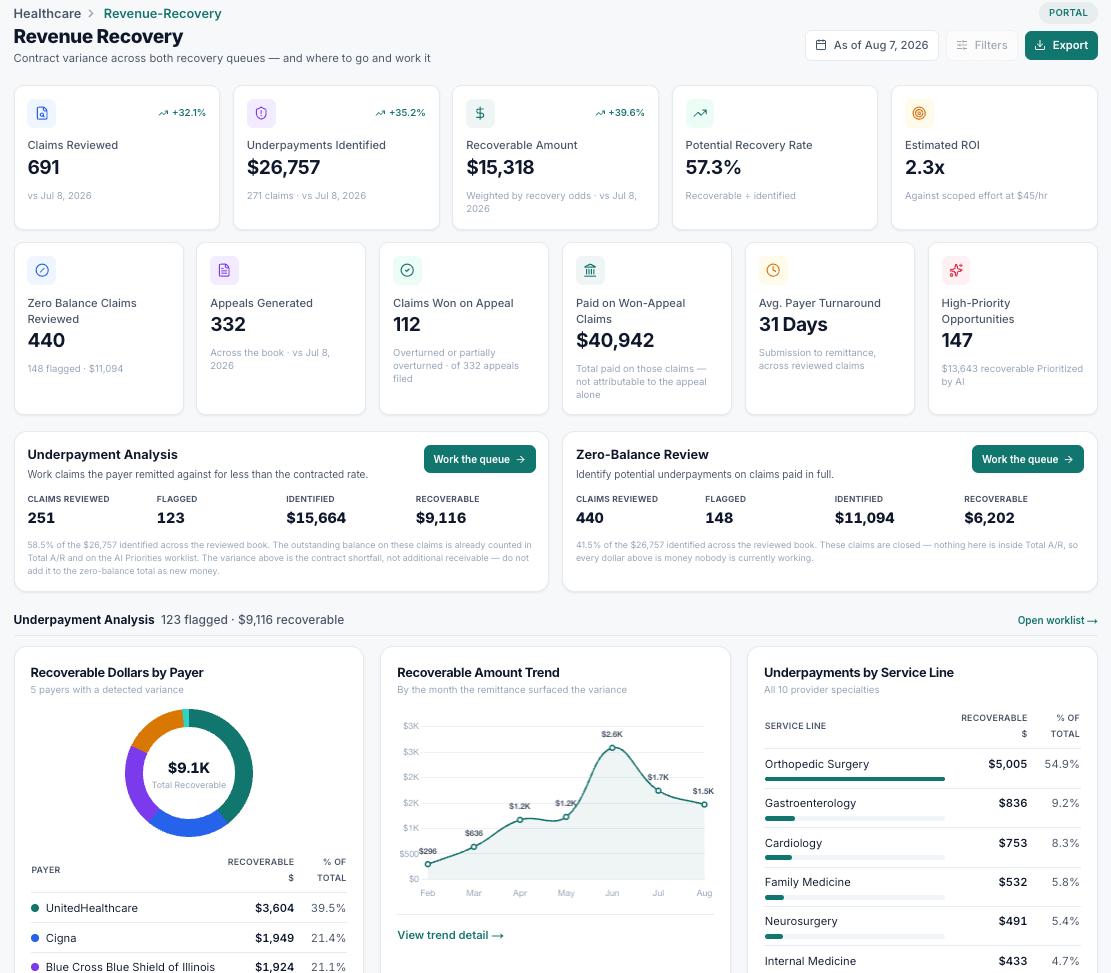
Both recovery queues in one view: claims reviewed, underpayments identified, the recoverable amount, and where it sits by payer and service line.
Each service line is measured against what that payer agreed to pay for that procedure — so a payer that has loaded a code wrong is caught everywhere it touches, not once by luck.
A shortfall is classified as bundling, a contract variance, an unhonoured modifier, a multiple-procedure reduction or a plain fee-schedule difference — so you know which conversation to have.
Variance on an open claim is a contract shortfall on receivable you already track. Variance on a closed claim is entirely new. The product never lets you add the two together.
Findings carry a confidence rating and an expected recovery, so a marginal one-off never sits at the same weight as a pattern repeating across dozens of claims.
Negotiated rates by payer and procedure become the yardstick every remittance is measured against.
Expected against allowed, at line level, so a shortfall buried inside a partially paid claim still surfaces.
Each one arrives with a cause, an expected recovery and the evidence you would need to dispute it.
Review, confirm or dismiss, assign an owner, and push what you are keeping onto the worklist.
A claim that closed at zero looks finished to every report you have. If the payer allowed less than your contract says, that gap was never a receivable, never appeared in A/R and never reached anyone's queue. It is the one pool where a recovered dollar is genuinely new.
Two queues
The payer remitted but a balance remains. The variance is contract shortfall, not additional receivable.
Paid in full, nothing outstanding. A shortfall here is money nobody is currently working.
The easiest way to triple an underpayment headline is to sweep patient responsibility into it. A deductible balance is money the member owes, not a payer shortfall — and in most books it dwarfs the real variance. It is excluded, and the page says so.
What is deliberately excluded
A deductible or coinsurance balance is the member's, not a payer underpayment.
Government rates are not privately negotiated ones.
Differences inside ordinary contract rounding.
Where the cost to collect exceeds the recovery.
A list of suspected underpayments is not leverage. What moves a payer is a repeating pattern with the numbers attached — the same procedure, the same contract, priced short across a run of claims.
Causes it distinguishes
Paid below the payer's own stated allowed amount.
No adjustment code explains the shortfall.
A payable line allowed nothing at all.
The shortfall sits on lines carrying a pricing modifier.
Secondary surgical lines absorbed the reduction.
Two queues
Open balance and zero balance
Kept separate so nothing is counted twice
Line level
Every remitted line checked
Against the rate you actually negotiated
Explained
Every finding names its cause
Bundling, contract variance, modifiers and more
Net of noise
Patient balances excluded
A deductible is not a payer underpayment
We’ll walk your team through a live workspace using a sample of your data, and show exactly where the recoverable dollars are.