
Confirms coverage
Active coverage on the date of service, the right payer order when there are two plans, deductible and benefit detail — checked before billing rather than discovered after.
Coverage, authorisation, coding and submission checks run before the claim goes out. Every issue comes back in plain English, with what the payer will do about it and what to attach or change to clear it.
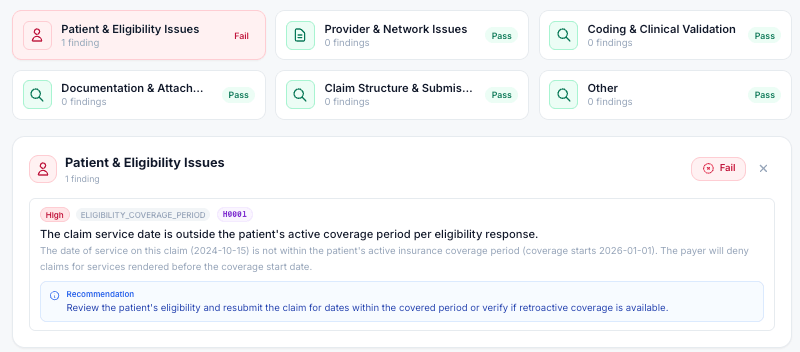
Validation results grouped by category. One failing category fails the claim, and each issue carries its explanation and the recommended correction.
Active coverage on the date of service, the right payer order when there are two plans, deductible and benefit detail — checked before billing rather than discovered after.
Procedure and diagnosis pairings, bundling conflicts, required modifiers, laterality, units and place of service — the edits that turn into avoidable denials.
Not a rule code and a shrug. Each issue says what the payer will do, the policy behind it, and the documentation needed to clear it.
Only genuinely blocking issues hold a claim. A judgement call is raised for review without stopping work, so the queue stays credible.
Coverage active on the date of service, the payer order confirmed, and any authorisation the service needs actually on file.
Codes, modifiers, diagnoses, units and place of service, against what this payer will accept.
Issues are grouped by area and rated, with a single failing area failing the claim rather than being averaged into a pass.
Apply the correction, attach what was asked for, and the claim goes out without the round trip.
“Claim failed validation” tells a biller nothing they can act on, and a queue of unactionable warnings is how validation gets switched off. Every issue here comes with what to do about it.
Areas checked
Coverage dates, plan status, coordination of benefits.
Rendering provider, identifiers, participation.
Procedure and diagnosis consistency, modifiers, bundling.
What the payer needs enclosed for this service.
Units, charges, place of service, formatting.
The encounters that quietly cost the most are the ones sitting between the visit and the claim — coverage that lapsed, an authorisation nobody chased, charges never captured. They generate no denial because they generate no claim.
Caught before submission
The plan was not in force when the service was rendered.
Two coverages, and the payer order is not established.
The service requires one and none is on the claim.
The approval lapsed or its units ran out before the visit.
Documentation incomplete, so the encounter cannot be billed.
The claim would reject at the payer's front end as it stands.
A suggested code you cannot trace is a code you have to re-derive yourself, which is slower than coding it from scratch. Each suggestion shows the document and the exact sentence in the chart it came from.
On every suggested code
Which chart or note it was drawn from.
The sentence that justifies it, quoted.
How strongly the documentation supports it.
Compliant, needs review, or not valid for this payer.
Before billing
Caught while it is still fixable
Not after the payer has said no
Explained
Plain English on every issue
With the documentation to attach
Cited
Suggested codes show their source
The sentence in the chart behind each one
Prioritised
Blocking issues come first
Judgement calls flagged, not enforced
We’ll walk your team through a live workspace using a sample of your data, and show exactly where the recoverable dollars are.