
Skip to content
AI Appeals

Appeals that take minutes, and hold up.

Pick a denial and a full reconsideration letter is drafted from the claim's own record — the denial reason, the services billed, the diagnoses, the rendering provider, the contract shortfall. Your specialist reviews and sends instead of starting from a blank page.
  • Drafted from the claim record
  • Matched to the denial type
  • Appeal windows tracked per payer
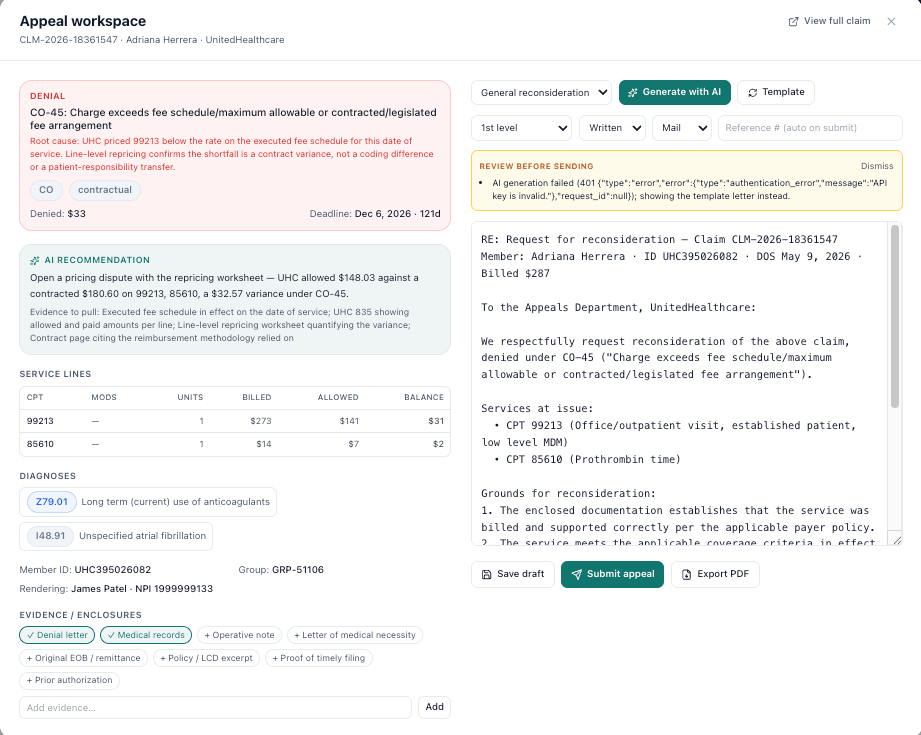
Appeal workspace for a CO-45 fee schedule denial, with an AI recommendation to open a pricing dispute and a drafted reconsideration letter ready to submit.

The appeal workspace: the denial and its root cause, the recommended argument, the evidence to pull, and the drafted letter ready to review.

What it does

Writes the first draft

The denial reason, the service lines and modifiers, the diagnoses, the provider and any authorisation already on file — nothing has to be looked up and retyped.

Assembles the evidence

Each denial type brings its own enclosure list, and a pricing dispute swaps the denial letter for the repricing worksheet, the remittance and the fee schedule.

Watches the window

Appeal deadlines follow each payer's own terms rather than one global limit, and the workspace stops pushing an appeal once the window has closed.

Produces something sendable

A print-ready packet as real selectable text, plus a recorded submission with a reference number, appeal level, format and delivery method so it stays tracked.

How it works

  1. 1

    The right denial is picked

    A claim carrying several denials leads with the one holding the most money, so the letter argues what actually matters.

  2. 2

    The argument is matched

    A timely-filing appeal and a bundling appeal have almost nothing in common. The denial type selects a genuinely different case, not boilerplate with the nouns swapped.

  3. 3

    The letter is drafted

    Written from the claim's own facts and presented as a working draft with the enclosure list already assembled.

  4. 4

    You review, export, record

    Edit anything, set level and delivery, export the packet, and log the submission with its reference number.

A biller signs this, so it has to be right

An appeal is a formal statement to a payer. A drafting tool that invents a procedure code, a policy number or an authorisation is not producing a rough draft — it is producing a liability. Accuracy here is a requirement, not a quality target.

  • The letter is written from the claim's own record rather than from general knowledge about claims like it.
  • It never asserts that a prior authorisation exists unless one is genuinely on file — it asks the payer to check its records instead.
  • On a claim the payer paid short, it argues the contract rather than describing the claim as denied.
  • Nothing reaches you with placeholders left in it to fill by hand.

Matched to the denial

  • Coding and modifier
  • Medical necessity
  • Timely filing
  • Prior authorization
  • Eligibility and coordination of benefits
  • Contract underpayment
  • General reconsideration

The packet, not just the letter

Appeals are upheld for missing paperwork as often as for a weak argument. The workspace assembles the enclosure list alongside the letter, and changes it when the nature of the dispute changes.

  • A standard enclosure checklist you tick through, plus anything specific you want to add.
  • A pricing dispute automatically swaps in the repricing evidence — there is no denial letter to enclose when the claim was paid.
  • Editing the enclosure list never silently rewrites the letter you have already worked on.
  • Export produces selectable text, not a screenshot, so a payer portal upload stays searchable.

Enclosure checklist

  • Denial letter
  • Medical records
  • Operative note
  • Letter of medical necessity
  • Original EOB / remittance
  • Policy / LCD excerpt
  • Proof of timely filing
  • Prior authorization

It will tell you not to bother

The most expensive appeal is the one that was never winnable. Patient responsibility is not appealable. A closed window is not appealable. Rather than leaving a button that leads nowhere, the workspace changes what it recommends.

  • A deductible or coinsurance balance is routed to the statement cycle, not to an appeals queue.
  • Once a window has closed the appeal call-to-action goes away instead of sending someone on a futile errand.
  • Where a shortfall is real but the window has passed, the recommendation becomes a contract conversation.
  • Appeal windows and filing limits follow the payer, so the deadline column stays meaningful across your mix.

What you set before sending

  • Appeal level

    First level, second level or external review.

  • Format

    Written, payer portal or phone.

  • Delivery

    Mail, fax or portal.

  • Reference number

    Yours, or assigned automatically on submission.

From denial to reviewable draft

Minutes

From denial to reviewable draft

Instead of a specialist starting from a blank page

Built on the claim's own facts

From record

Built on the claim's own facts

Not on general knowledge about similar claims

Real appeal windows tracked

Per payer

Real appeal windows tracked

Not a single global filing limit

Export for mail, fax or portal

Print ready

Export for mail, fax or portal

Selectable text, with the submission logged

Common questions

Does it submit the appeal to the payer for us?
Not today. It drafts the letter, assembles the enclosure list, exports a print-ready packet for mail, fax or portal upload, and records the submission with a reference number, appeal level and delivery method so the appeal stays tracked.
Is the letter usable as-is?
It is a working draft written from the claim's own record, and most of the time the review is a read rather than a rewrite. You can edit the text, change the argument, and add or remove enclosures before it goes out.
How does it handle a claim that was paid but paid short?
As a contract dispute rather than a denial. The letter argues the fee schedule and the line-level shortfall, the enclosures switch to the repricing evidence, and the clock runs from the remittance date.
Will it appeal things it should not?
No. Patient responsibility is never treated as appealable, and once a payer's window has closed the workspace stops offering an appeal and points to the remaining option instead.

See AI Appeals run against your own claims.

We’ll walk your team through a live workspace using a sample of your data, and show exactly where the recoverable dollars are.