
Ranks by recoverable value
What is genuinely collectable, not what was billed — so a contractual adjustment you already agreed to never pushes a claim up the list.
Every open claim is ranked on what can actually be done about it today, how much is genuinely recoverable, and how close it is to a deadline. Your team opens a shortlist worth working rather than a backlog sorted by age.
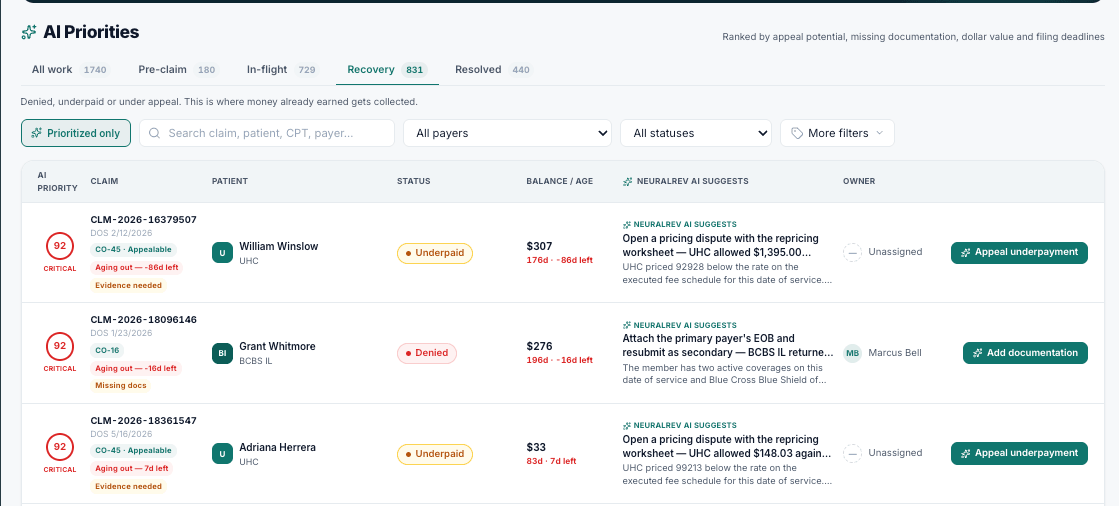
The AI Priorities worklist: the priority score, the denial and deadline flags, the recommended action, and the reasoning behind it on every row.
What is genuinely collectable, not what was billed — so a contractual adjustment you already agreed to never pushes a claim up the list.
A workable claim with a closing appeal or filing window surfaces regardless of size, because a missed window is not a partial loss.
Not “follow up” — the specific move. Append the modifier, attach the primary EOB, open a pricing dispute, with the root cause and the evidence to gather.
Pre-claim, in-flight and recovery are different jobs. Somebody clearing authorisation holds should not be scrolling past denials they cannot act on.
What state it is in, what it is worth, how long it has sat and how much window is left.
A priority and a tier, plus the badges that explain them — the denial reason, days remaining, missing paperwork.
The root cause, the next step, the evidence to gather, and how likely this kind of claim is to be recovered.
Filtered to what is genuinely worth working, with the full book one toggle away.
A team will quietly abandon a worklist the moment its order stops making sense. So every claim can tell you why it sits where it does, in terms a biller recognises — and the answer is the same every time they look.
What the ranking weighs
A coding error you can correct and rebill beats one already sitting with the payer.
The balance actually at stake, not the billed amount.
Older money is harder money, and it gets weighted that way.
A closing appeal or filing deadline outranks almost everything.
A worklist has to be readable at a glance or it becomes a spreadsheet people export and ignore. Each row carries a small set of flags drawn from the claim itself, so the shape of the work is obvious before anyone opens it.
Row vocabulary
A denial with a live dispute path still open.
Days remaining on the appeal or filing window.
The payer is pending on records or coordination of benefits.
The recommendation names documents to gather first.
Remitted below contract, and the claim is still open.
Most worklists filter on claim status, and that quietly hides work. A claim can be denied and then partially paid, or denied and already under appeal. In both cases the status no longer reads “denied” — but the money is still contested, and a status filter will walk straight past it.
Lanes
Everything open, ranked. A to-do list, not an archive.
Coverage, authorisation, coding and submission holds.
Submitted and waiting. Chase what has gone quiet.
Denied, underpaid or under appeal.
Paid and closed, kept for zero-balance review.
Ranked
By what is worth doing next
Not by whatever happens to be oldest
Explainable
Open any claim and see why
The order is never a black box
Deadline aware
Closing windows surface first
A missed window is a total loss, not a partial one
By stage
Pre-claim, in-flight, recovery
So a queue matches the job someone is doing
We’ll walk your team through a live workspace using a sample of your data, and show exactly where the recoverable dollars are.